After School Programs
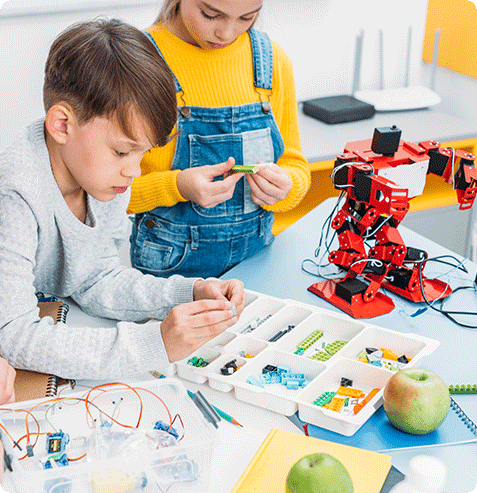
STEM (Science, Technology, Engineering, and Mathematics) is no longer limited to building with blocks or programming simple robots. Today, it’s a gateway to creativity, imagination, and interdisciplinary learning. From physical movement to music and manual arts, STEM is being reimagined in ways that spark curiosity and encourage deeper engagement from students of all ages.
At HOKALI, we believe in expanding the definition of STEM to unlock imagination, drive innovation, and better serve the diverse interests and learning styles of students. This white paper highlights key takeaways from the 2025 BOOST Conference and explores how we can bring more creativity into STEM education through variety, purpose, and student-centered design.
Key Challenges in Traditional STEM Programming
While STEM remains a crucial pillar in 21st-century education, several challenges persist:
Limited Variety: Many programs rely heavily on building sets, which can feel repetitive or fail to reach students with different interests.
Lack of Integration: STEM is often treated as a standalone subject, missing opportunities to connect with other disciplines like physical education, music, or art.
Low Engagement for Certain Age Groups: Traditional models may not captivate younger learners or those with limited prior exposure to STEM.
Three Creative Approaches That Redefine STEM Learning
1. STEM Can Be Active: Exploring Through Wearable Play
Emerging STEM innovations are showing how physical activity and wearable technology can come together to create highly immersive educational experiences. Using interactive devices that respond to movement, proximity, and environmental cues, students engage in collaborative games where they solve academic challenges in real time.
These formats transform education into a playful, dynamic process where concepts like logic, communication, strategy, and programming are introduced naturally. Beyond supporting physical activity, these gamified environments also nurture social-emotional skills by encouraging empathy, teamwork, and decision-making.
2. STEM Can Be Musical: Tech-Enhanced Instrument Building
Some STEM programs are redefining music education by enabling students to play instruments using technology rather than traditional tools. Through the use of circuits, sensors, and coding, these activities allow students to trigger and manipulate sounds that replicate real instruments, transforming how music can be experienced and taught.
These experiences not only teach fundamental concepts of sound, rhythm, and digital interaction but also demonstrate how technology can improve creative expression. By blending the arts with coding and engineering principles, this type of program expands the definition of STEM and opens the door to more inclusive, engaging learning opportunities.
3. STEM Can Take Flight: Drone Programming & Prototyping
Drone education is becoming a powerful and engaging way to introduce students to the intersection of hardware and software. In hands-on programs, students learn to assemble, code, and pilot drones, gaining technical skills while also building problem-solving abilities and real-world confidence.
These activities go beyond basic STEM by incorporating concepts such as aerodynamics, physics, spatial reasoning, and even entrepreneurship. As students work through prototyping and flight challenges, they experience firsthand how technology can be applied creatively and purposefully in dynamic, real-world contexts.

HOKALI’s Approach to STEM
At HOKALI, we’re inspired by these examples and committed to building a STEM program that’s as diverse and dynamic as the students we serve. Here’s how we’re integrating these insights:
Creative Curriculum Design: We offer more than robotics; we include STEM-based physical games and real-world problem-solving projects.
Flexible Tools & Kits: We work with instructors to design kits and lesson plans that adapt to different spaces, budgets, and student levels.
Instructor Empowerment: Through the HOKALI Academy, instructors receive hands-on training in emerging STEM trends and the confidence to try new approaches.
Student-Centered Experiences: Every program is designed with engagement and imagination at the core, allowing students to explore their interests and unlock their potential.
The Result: A New Era of STEM Education
When students experience STEM through variety and creativity, the outcomes speak for themselves:
Increased curiosity and participation, especially among underrepresented groups in STEM
Stronger student-instructor connections through collaborative, hands-on learning
Broader skill development, technical, creative, and interpersonal
STEM doesn’t have to look the same everywhere or for everyone. By embracing variety and reimagining what’s possible, we can make STEM more inclusive, exciting, and transformative.
Discover how HOKALI is helping schools reimagine STEM, one inspired student at a time.